International inheritance taxation: the risk matrix for cross-border wealth

Abstract
International inheritance taxation is one of the most delicate areas of contemporary wealth planning. The mobility of high-net-worth families, the geographic dispersion of assets and the use of trusts, holding companies, foundations and life insurance policies increasingly create situations in which several jurisdictions may claim taxing rights over the same generational transfer. The risk does not depend solely on the nominal inheritance tax rate, but on the interaction between the residence of the deceased, domicile, citizenship, residence of the heirs, asset situs and the tax qualification of wealth planning structures. This article proposes a risk matrix applied to a first group of relevant jurisdictions — Italy, France, Germany, Spain, Switzerland, the United Kingdom, the United States, Canada, Australia, Singapore, the United Arab Emirates and Argentina — with the aim of providing an operational framework for international families, family offices and wealth advisors.
1. A succession that is no longer domestic
Consider an Italian entrepreneur who has transferred his residence to Switzerland, owns real estate in Spain, holds an offshore holding company, maintains a financial portfolio with Swiss intermediaries, owns a Luxembourg life insurance policy and has two children resident respectively in France and in the United States.
Upon his death, the issue will not simply be to determine which State applies the highest tax rate. The real issue will be to understand how many States may, each under its own rules, claim taxing rights over the same transfer of wealth.
Italy may question the tax residence of the deceased and the treatment of assets still falling within its taxing perimeter. Switzerland may consider the relevant cantonal domicile. Spain may tax real estate located in its territory. France may tax the inheritance received by the French-resident beneficiary. The United States may become relevant because of citizenship, domicile or the presence of US situs assets. The life insurance policy and the holding company would then need to be classified under the different legal and tax systems involved.
An international succession is no longer a domestic event. It is a point of collision between different tax jurisdictions.
This collision is not always immediately visible. It may remain silent until the opening of the succession, when the heirs discover that the same family wealth has been read, classified and taxed in different ways. At that point, the absence of planning becomes a cost: tax, legal, financial and family-related.
2. The issue is not the tax rate, but the connecting factor
In practice, comparisons between inheritance tax systems are often reduced to an apparently simple question: where is inheritance tax lower?
That question is incomplete. Sometimes, it is misleading.
The real issue is not only the tax rate, but the connecting factor that allows a State to tax. A country with a low tax rate may become relevant if it taxes the worldwide estate of the deceased. A jurisdiction without inheritance tax may nevertheless trigger capital gains tax upon death. A country that is favourable for the settlor or deceased may not be favourable for the heirs. A seemingly neutral jurisdiction may become critical if it hosts real estate, local shareholdings or trusts that are not recognised for tax purposes.
In cross-border estates, tax risk does not arise from a single jurisdiction, but from the overlap of multiple taxing claims based on different connecting factors.
There are five main connecting factors.
The first is the tax residence of the deceased. Some jurisdictions tax the entire estate if the deceased was tax resident there. In such systems, the worldwide estate may fall within the taxable perimeter, subject to exemptions, credits or treaties.
The second is domicile, a concept that is particularly relevant in common law systems. Domicile may be more stable than residence and may survive even apparently significant relocations. The United Kingdom is emblematic: domicile or deemed domicile may be decisive for Inheritance Tax purposes.
The third is citizenship. The United States is the best-known model: US citizenship may generate estate tax exposure even when the family, professional and patrimonial centre of life has long since moved elsewhere.
The fourth is the residence of the heir or beneficiary. In certain jurisdictions, taxation does not look only at the deceased, but also at the person receiving the wealth. This is particularly relevant in France, but also in Germany and Spain under their respective rules. This criterion is often underestimated in international families, where heirs live in different States.
The fifth is the situs of the assets. Real estate is almost always the strongest connecting factor. Even States without a general inheritance tax may apply indirect taxes, transfer taxes, probate fees or local taxes on assets located in their territory.
International inheritance planning begins at the intersection of these criteria.
3. First group of jurisdictions: models and operational risks
Italy
Italy has, in comparative terms, a relatively moderate inheritance tax system. Ordinary rates are lower than those applied in France, the United Kingdom, the United States or Germany, and the exemptions available for spouses and descendants make the Italian system competitive for many families.
The Italian risk is therefore not primarily quantitative. It is structural.
If the deceased is tax resident in Italy, the scope of taxation may extend to worldwide assets. If, instead, the deceased is not resident, assets located in Italy become relevant. In addition, wealth planning instruments — trusts, destination constraints, family arrangements, holding companies and life insurance policies — require careful classification.
Operational alert: Italy may be fiscally competitive, but it requires coordination with the jurisdictions where the assets are located and with the jurisdictions of residence of the heirs.
France
France is one of the most sensitive jurisdictions in the risk matrix. The French system may bring a succession within its taxing scope through broad connecting factors: the tax residence of the deceased, the tax residence of the beneficiary and the location of assets in France.
The most delicate profile concerns heirs resident in France. Even where the settlor or deceased is not French and the assets are not entirely French, the position of the beneficiary may generate taxation. This makes France a particularly critical jurisdiction for international families with children, a spouse or beneficiaries established in France.
Assurance-vie, lifetime gifts, démembrement de propriété and progressive planning may play an important role, but only if implemented in advance and coordinated with the other jurisdictions involved.
Operational alert: France may turn a foreign succession into a taxable event through the residence of the beneficiary.
Germany
Germany combines two elements: progressive inheritance and gift taxation and connecting factors that look both at the deceased and at the beneficiary. If the testator or the heir is tax resident in Germany, the German system may bring the succession within its taxing scope. In the absence of German-resident persons, assets located in Germany become relevant.
The existence of significant allowances, especially for spouses and children, should not lead to underestimating the risk. The German system also takes account of acquisitions made within a relevant time period, with effects on the aggregation of gifts and inheritances.
Foundations, family holding companies and planned lifetime gifts may be effective tools, but they require early planning.
Operational alert: Germany becomes critical when even one of the central persons — the deceased or the beneficiary — is German resident.
Spain
Spain must be analysed on two levels: national and regional. Inheritance and gift tax is strongly affected by the Autonomous Communities, which may provide very different benefits, reductions and treatments.
This makes any abstract assessment of Spanish risk impossible. It is necessary to know where the beneficiary is resident, where the assets are located, which Autonomous Community is involved and whether there are Spanish real estate assets or shareholdings.
Spain is also relevant for families holding residential real estate, second homes or tourist-real-estate assets in its territory.
Operational alert: Spain cannot be assessed only at national level; the risk matrix must include the regional level.
Switzerland
Switzerland does not have a uniform federal inheritance tax system. Competence is mainly cantonal. In many cantons, the treatment of spouses and descendants is favourable, but territorial differences are essential.
The cantonal domicile of the deceased and the situs of Swiss real estate are the two main elements. Switzerland may be highly favourable, but it is not a uniformly neutral jurisdiction. The risk lies less in Swiss law as such than in the need to coordinate the cantonal regime with the jurisdictions of the heirs and of foreign assets.
Foundations, insurance policies, holding companies and foreign trusts may play a role, provided they are consistent with the overall family and wealth structure.
Operational alert: Switzerland is favourable only if the relevant canton is precisely identified and the rest of the international structure is properly coordinated.
United Kingdom
The United Kingdom is a jurisdiction of high technical complexity. Inheritance Tax cannot be understood without analysing domicile, deemed domicile, excluded property, trusts, UK situs assets and recent legislative reforms.
Residence alone is not enough. A person may not live permanently in the United Kingdom and still have a risk profile if considered domiciled there or if holding UK situs assets. Conversely, a seemingly foreign structure may be brought within the UK tax perimeter if it has not been properly designed.
Trusts, excluded property structures, life insurance and family investment companies are relevant tools, but they are also highly exposed to legislative and interpretative changes.
Operational alert: in the United Kingdom, domicile may matter more than apparent residence.
United States
The United States is one of the most delicate areas of international estate planning. The federal estate tax system looks at citizenship, domicile and, for non-resident non-citizens, US situs assets.
The most critical profile concerns US citizens. Citizenship may generate worldwide exposure, even where the person lives permanently outside the United States. For non-citizen non-residents, the risk focuses instead on US assets: real estate, securities, equity interests and investments qualifying as US situs assets.
Dynasty trusts, insurance trusts, LLCs, estate freezes and investment structures may reduce the risk, but only if coordinated with the tax position of the beneficiaries and with any applicable treaties.
Operational alert: US citizenship and US situs assets are two factors that must always be mapped separately.
Canada
Canada does not apply a formal estate tax. This fact, often seen as favourable, must be read carefully. Upon death, a deemed disposition of capital property may occur, potentially triggering taxation of latent capital gains.
The Canadian risk is therefore not an inheritance tax, but a capital gains tax triggered by death. This may be particularly relevant for shareholdings, real estate, financial portfolios and assets with significant unrealised appreciation.
Trusts, estate freezes, holding companies and insurance planning are recurring tools in Canadian practice, but they must be coordinated with the residence of the heirs and with any foreign assets.
Operational alert: Canada shows that the absence of estate tax does not mean tax neutrality.
Australia
Australia also does not apply a general inheritance tax. However, death may trigger indirect tax consequences, particularly in relation to capital gains tax and superannuation.
Planning must take account of Australian assets, the treatment of non-resident beneficiaries, real estate interests and the proper transfer of pension-related positions. Australia is therefore less onerous from a direct inheritance tax perspective, but technically it is not neutral.
Operational alert: the Australian risk is often indirect, connected to CGT, superannuation and asset classification.
Singapore
Singapore has abolished estate duty and is one of the most attractive jurisdictions for family offices, Asian wealth and international governance structures. Trusts, holding companies, VCCs, life insurance and family office regimes make Singapore a leading wealth hub.
However, local tax favourability does not automatically solve the tax issues in the countries of origin of the settlor or the beneficiaries. A Singapore structure must be tested against tax residence, reporting, CRS/FATCA, beneficial ownership and classification in the foreign jurisdictions involved.
Operational alert: Singapore is favourable, but it does not neutralise the taxation of the other jurisdictions connected to the family.
United Arab Emirates
The United Arab Emirates do not apply a general inheritance tax on individuals. The risk is therefore less tax-driven in the strict sense and more civil-succession oriented: applicable law, succession to local assets, probate, land registries, DIFC wills, ADGM structures, foundations and possible interaction with personal status law.
For non-Muslim families or families with local assets, documentary planning is essential. Foundations, holding companies and wills registered in free zones may play a decisive role in governing the generational transfer.
Operational alert: in the UAE, the main risk is not inheritance tax, but the coordination of local assets, testamentary wishes, registries and applicable law.
Argentina
Argentina does not have a general federal inheritance tax, but the Province of Buenos Aires applies taxes on gifts and inheritances where certain conditions are met. Other provinces may introduce similar charges.
The Argentine risk is therefore variable and local. It is necessary to assess asset situs, the relevant province, real estate, local shareholdings, wealth taxes and succession formalities. A federal-level assessment alone would be insufficient.
Operational alert: Argentina requires provincial analysis; the risk cannot be understood only at national level.
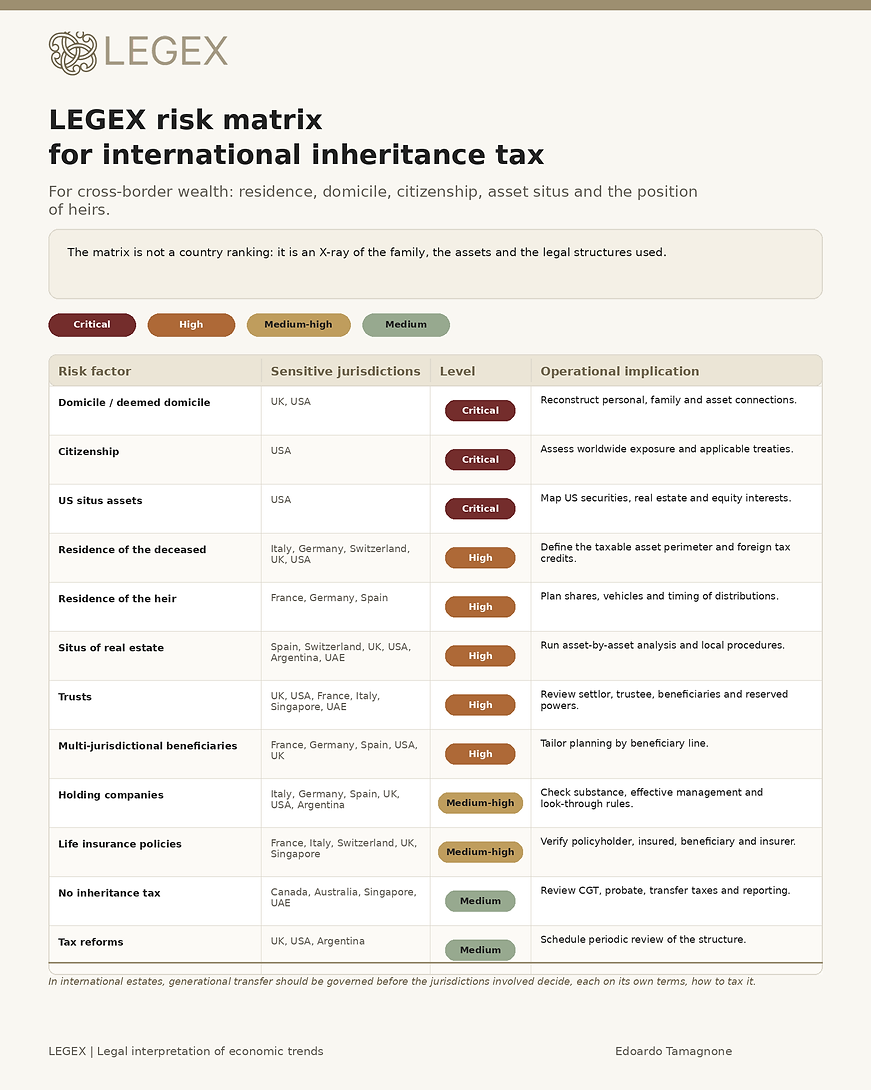
4. The graphic matrix of international inheritance tax risk
The risk matrix is not a country ranking. It is an X-ray of the family, the assets and the legal structures used.
For this reason, the matrix must be built around risk factors, not around abstract jurisdictions. Its purpose is to reveal where the family structure is vulnerable.
Reading the matrix
Critical area
Domicile, US citizenship and US situs assets are the most sensitive factors. They may generate broad exposure even when the family believes it has already shifted its wealth centre elsewhere.
High-risk area
Residence of the deceased, residence of the heirs, situs of real estate, trusts and multi-jurisdictional beneficiaries are the factors that most frequently generate double taxation or interpretative uncertainty.
Technical-operational area
Holding companies, life insurance policies, systems without inheritance tax and tax reforms require technical review: the risk is not always immediate, but may arise at the moment of tax classification or succession implementation.
5. Three paradigmatic cases
Case 1: Italian deceased, French-resident heir, real estate in Spain
A deceased person tax resident in Italy leaves an estate consisting of Italian assets, foreign financial portfolios and real estate in Spain. One of the heirs is resident in France.
The matrix shows three potential layers of risk: Italy because of the residence of the deceased, France because of the position of the heir, and Spain because of the situs of the real estate.
The issue is not to determine which tax is higher. The issue is to establish whether the three taxing claims may overlap, whether tax credits are available, whether treaties apply and whether the succession structure can prevent an ex post tax conflict.
Case 2: Family with a US citizen and European assets
A European family includes a US citizen. The wealth consists of European shareholdings, real estate in Italy and Spain, international financial portfolios and fund interests with US exposure.
US citizenship becomes the gateway to risk. It is not enough to look at the family’s European residence. Estate tax, gift tax, US situs assets, any trusts established and the compatibility of the European structure with US rules must all be analysed.
The matrix classifies this scenario as critical, because US citizenship may turn an apparently European plan into a global planning exercise.
Case 3: Residence in the UAE or Singapore with European beneficiaries
An entrepreneur transfers residence to the United Arab Emirates or Singapore, relying on the absence of local inheritance tax. The beneficiaries, however, are resident in France, Germany and Spain.
The jurisdiction of residence of the settlor or deceased may be favourable, but the position of the heirs reopens the risk analysis. The local structure — UAE foundation, Singapore trust, holding company or life insurance policy — must be tested in the jurisdictions of the beneficiaries.
False security arises from assuming that the absence of tax in the country of the deceased closes the analysis. In reality, it often opens it.
6. Operational implications for planning
Effective international inheritance planning does not eliminate risk: it makes it visible, measurable and governable.
The first tool is the succession tax map. For each family, it should identify:
-
tax residence of the settlor or deceased;
-
domicile;
-
citizenship;
-
residence of the heirs;
-
location of assets;
-
nature of assets;
-
ownership structures;
-
trusts, foundations, holding companies and life insurance policies;
-
prior gifts;
-
applicable estate tax treaties;
-
foreign tax credits;
-
indirect taxes;
-
liquidity needs;
-
local probate or succession procedures.
The second tool is beneficiary-line analysis. Not all heirs have the same exposure. An heir resident in France may generate a different risk from an heir resident in Switzerland, Singapore or the UAE. Planning must therefore avoid uniform solutions for beneficiaries who are fiscally different.
The third tool is the review of illiquid assets. Real estate, private company shares, art collections, shares in family companies and real-estate assets held through holding companies may generate taxes without immediate liquidity. This is where insurance policies, financing, corporate clauses and family agreements become part of the tax strategy.
The fourth tool is the review of fiduciary structures. Trusts and foundations must be analysed not only in the jurisdiction of establishment, but in all relevant States: settlor, trustee, beneficiaries and assets.
The fifth tool is periodic review. Inheritance taxation is an area exposed to reform, especially in jurisdictions with high wealth taxation pressure. A structure that is efficient today may become vulnerable tomorrow.
7. Conclusion
International inheritance taxation is a new frontier of wealth planning. International families cannot rely on standardised structures, nor on assessments based solely on nominal tax rates.
Vulnerability arises from the lack of coordination between jurisdictions. A wealth structure may be sound from a civil law perspective and fragile from a tax perspective. It may be efficient in the country of the settlor and inefficient in the country of the heirs. It may be protected by a trust, but exposed to reclassification. It may be held through a holding company, but caught by look-through rules. It may be transferred to a favourable jurisdiction, yet remain fiscally exposed elsewhere.
The risk matrix allows planning to move from a reactive approach to a preventive one. It does not serve to choose an abstractly better country. It serves to understand where the family is exposed.
In international estates, generational transfer should not be left to the accidental geography of assets and residences. It must be governed before the jurisdictions involved decide, each on its own terms, how to tax it.
Essential sources
-
Italian Revenue Agency / Italian legislation on inheritance and gift tax.
-
PwC Worldwide Tax Summaries: Italy, France, Germany, Spain, Switzerland, Canada, Australia, United Arab Emirates, Argentina.
-
GOV.UK: Inheritance Tax.
-
IRS: Estate Tax.
-
IRAS Singapore: Estate Duty.
-
Dubai / UAE property and succession planning references, to be checked for local assets.
-
Swiss cantonal sources for specific analysis.
-
Argentine provincial sources, particularly the Province of Buenos Aires.
Edoardo Tamagnone
International Tax & Wealth Advisor — Torino